How Embroidery Digitizing Prices Are Calculated by Professionals
Understanding embroidery digitizing prices helps you budget your projects, compare service providers, and get high-quality work. A professional digitizer, like the team at Aqua Digitizing, sets fair, accurate quotes based on standard industry factors.
You can get the best value for your next project by understanding how these prices are calculated.
Factors affecting embroidery digitizing prices
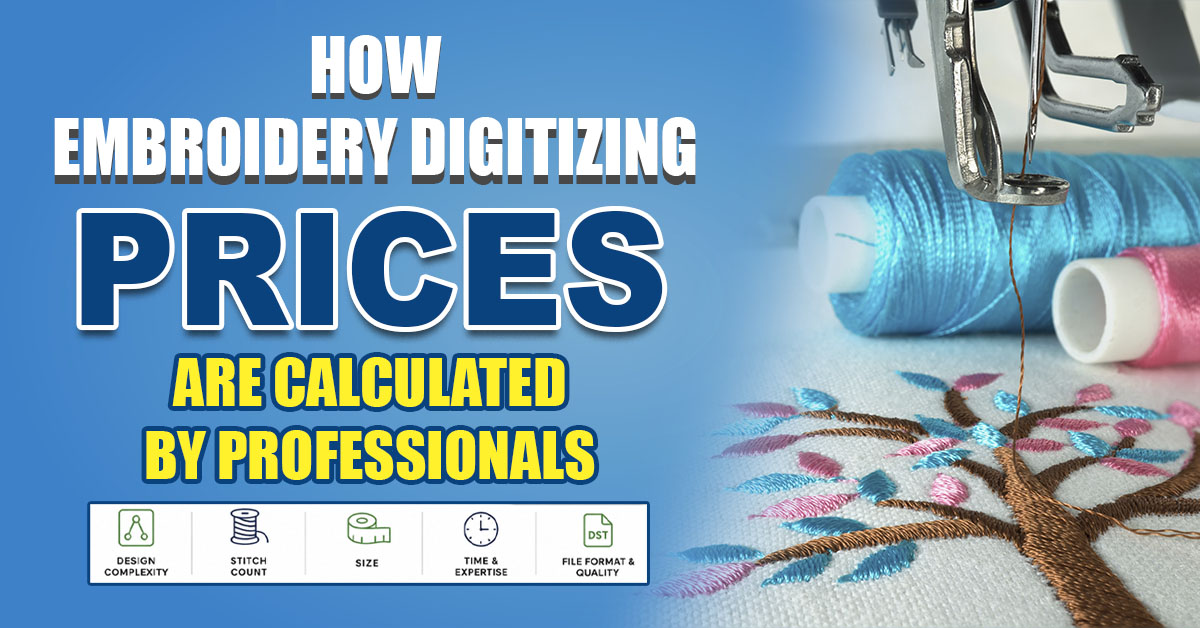
Digitizers evaluate several key elements in your artwork to figure out the price:
File complexity and artwork quality: Vector files (like AI or EPS) are easy to work with. Images with low resolution (like JPG or PNG) often need manual cleaning and extra preparation time.
There are different stitch types and densities for different areas. Text is done with satin stitches, while large areas are done with fill stitches. Denser designs and higher stitch counts take longer to digitize and run, so they’re more expensive.
When you change thread colors, the machine stops and resets. Thread management and setup time are more complicated for designs with frequent color changes.
Intricate details and tiny lettering require highly meticulous manual work to keep them from bunching up when sewn.
To look clean, difficult or stretchy fabrics (like knits, performance wear, or leather) need extra foundational underlay stitches.
Rush fees are usually added to projects that need an expedited turnaround time.
Models of pricing you’ll see
Your project will usually be priced using one of these methods:
Based on the total stitch count of the final design, per 1,000 stitches. Commercially, this is the most common model.
Simple designs or standard corporate logos (often under a certain size, like left chest) are flat-priced.
Organizes rates into clear categories, like simple, moderate, and highly complex.
A flat fee or percentage added for urgent deadlines.
What to Expect for Price Ranges
Prices for simple designs range from $20 to $50 USD, depending on size.
Moderate Complexity: Usually in the mid-$50s to low hundreds.
High-detail, bespoke full-jacket backs or oversized patches can cost hundreds to $1,000 USD.
Best Practices to Keep Costs Down
You can easily optimize your files to get the best rates without sacrificing quality:
You want to simplify your artwork, so don’t put too much detail in, minimize tiny text, and don’t have too many small, crowded sections.
You can minimize unnecessary thread changes on your embroidery machine by grouping colors together.
Make Sure Your Digitizer Knows What Fabric You’re Using: Tell your digitizer what fabric you’re using upfront so they can choose the right stabilization settings.
Always ask for clean, editable master files so you can make minor adjustments later without having to pay for a full redesign.
How to Get an Accurate Quote
Aqua Digitizing can provide you with a fast and precise quote if you give them these details:
Please send vector files or high-resolution images with transparent backgrounds whenever possible.
Don’t forget to specify the final dimensions in inches or centimeters.
Provide details about the garment (e.g., polo, cap, hoodie) and the fabric.
Choose the exact number of thread colors.
Make sure you know when you’re aiming to deliver.
Summary
The price of embroidery digitizing reflects design complexity, fabric science, and technical expertise. Understanding what drives these costs and communicating your project details clearly will help you secure fair pricing and get flawless, professional embroidery.
Frequently Asked Questions (FAQs)
1. How much does a standard left-chest embroidery digitizing design cost? For most standard designs, such as left-chest logos or corporate branding for caps and polos, pricing usually falls into a flat-rate category ranging between $20 to $50 USD. However, the exact cost depends heavily on the complexity of the artwork and the required stitch count. If you want an instant, transparent quote for your specific artwork, you can easily Get a Free Quote from Aqua Digitizing to get started today.
2. Why does the fabric type affect the final digitizing price? Different fabrics behave differently under the needle. Stretchy materials like performance wear, or heavy textures like leather and denim, require specialized foundational underlay stitches and push-and-pull compensation to prevent the design from puckering or shifting. Digitizing for these complex materials requires advanced technical expertise and more time. To understand how different textiles impact production, you can review the official Wilcom Embroidery Guidelines to a major industry standard site like Wilcom or Madeira).
3. Can I use the same digitized file for both a cap and a t-shirt? Generally, no. A design digitized for a flat surface like a t-shirt will distort or bunch up if run on a curved surface like a cap, which requires a specific “center-out, bottom-up” digitizing sequence. If you need a logo adapted for multiple product types, it’s best to let your professional team know upfront. Check out our comprehensive Custom Embroidery Digitizing Services to see how we optimize single designs for multiple garment types.